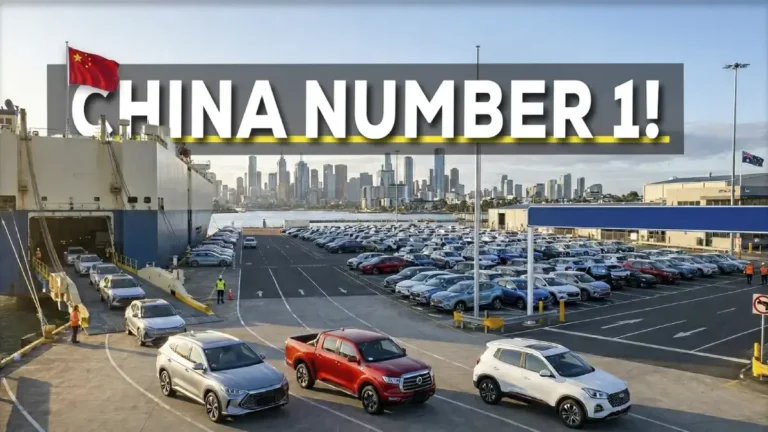
Image Credit: CarSource
SYDNEY – In a landmark development for the Australian automotive industry, China has officially overtaken Japan as the nation’s primary source of imported vehicles. This shift, recorded in February, marks the end of a multi-decade era of Japanese dominance and underscores a rapid transformation in consumer behavior across the continent.
Data released by the Federal Chamber of Automotive Industries (FCAI) reveals that February saw 22,300 Chinese-made vehicles arrive on Australian shores, securing a roughly 25% share of the total import market. For the first time since 1998, Japan fell to the second position with 21,600 units, followed closely by Thailand at 19,400 units.
This transition highlights a pivotal moment in the Australian market, which has long relied on Japanese engineering for its reliability and familiarity. However, the rise of affordable technology and the global push toward electrification have cleared a path for Chinese manufacturers to take the lead.
The surge in Chinese imports is inextricably linked to Australia’s burgeoning appetite for Electric Vehicles (EVs) and Plug-in Hybrid Electric Vehicles (PHEVs). Leading the charge is BYD, which has seen its sales skyrocket by 160% in the first two months of this year alone, reaching 10,200 units.
Other major players contributing to this momentum include:
Last year, EV sales in Australia topped 103,000 units, a sector where Chinese-manufactured cars currently hold a commanding presence.
“Australian consumers are prioritizing competitive pricing and advanced tech features. The absence of a domestic manufacturing base makes the market highly susceptible to global trends, and right now, China is setting the pace.” — Industry Analyst
Since the departure of local automotive manufacturing, Australia has become a critical battleground for global brands. With no domestic tariffs and a high demand for versatile vehicles like SUVs, the environment is ripe for expansion.
Since 2020, nine new Chinese brands have launched in Australia, bringing the total number of Chinese automakers in the country to over a dozen. This influx has provided consumers with a wider variety of “cost-effective alternatives” that were previously unavailable.
The momentum shows no signs of slowing down. Industry analysts suggest that if current pricing strategies and technological advancements continue, Chinese automakers could control more than 40% of the Australian new vehicle market by 2030.
As infrastructure for electric vehicles continues to improve across the country, the gap between the traditional leaders and the new Chinese powerhouse is expected to widen even further.
HINCKLEY, UK – Ahead of the highly anticipated official launch on April 6, a leaked document has pulled back the…
WUHU, China – Chery’s high-end subsidiary, Exeed, is poised to disrupt the global automotive landscape on April 17, 2026, with…
SHENZHEN – BYD is preparing to tighten its grip on the premium automotive sector with the upcoming launch of the…
BYD records 65% jump in overseas EV sales crossing 120,000 units in March 2026 amid rising fuel prices and global…
BYD unveils 2026 Seal 06 GT EV and Seal 06 DM-i Touring hybrid wagon with advanced battery tech, ADAS, and…
VinFast VF MPV 7 pre-bookings begin in India at Rs 21,000. Price announcement on April 15. Offers 500KM+ range, 7-seat…