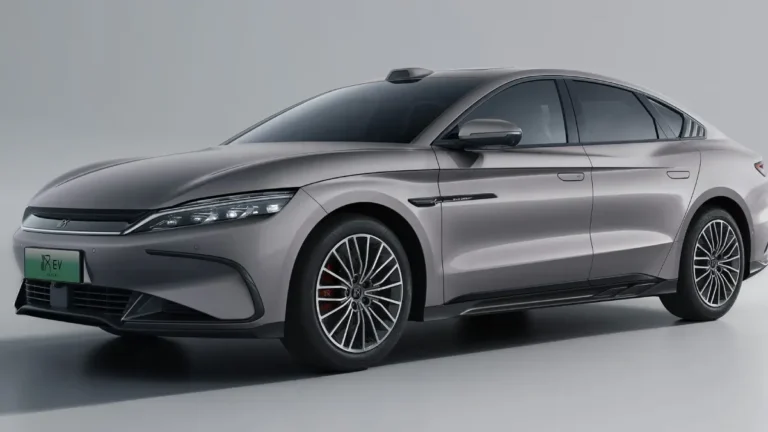
2025 BYD Han EV Luxury Full-Size Electric Sedan
The global electric vehicle (EV) market is witnessing a major shift as China’s BYD has surpassed Tesla to become the world’s top EV seller in 2025. While this milestone marks a significant achievement for the Chinese automaker, the company is simultaneously facing declining profits due to intensifying competition and pricing pressures. The latest developments highlight a changing EV landscape where volume growth does not necessarily translate into higher profitability.
BYD has officially overtaken Tesla in global electric vehicle sales, signaling a major power shift in the EV industry. The company sold around 2.25 million battery electric vehicles in 2025, significantly higher than Tesla’s approximately 1.64 million units.
This growth represents a year-on-year increase of nearly 28% for BYD, while Tesla experienced a decline in deliveries. The Chinese automaker’s broader strategy of offering a wide range of affordable as well as premium electric vehicles has played a key role in expanding its global footprint.
Additionally, BYD’s total vehicle sales, including hybrid models, reached around 4.6 million units, further strengthening its position in the EV market. The company’s dominance is particularly strong in China, the world’s largest EV market, but it is also expanding aggressively into Europe and other international regions.
Despite achieving record sales and revenue of approximately $116 billion in 2025, BYD reported a significant decline in profitability. The company’s net profit dropped by about 19 percent compared to the previous year.
This marks the first major profit decline for BYD in several years and reflects the growing challenges in the EV industry. Analysts attribute this drop to shrinking margins caused by aggressive pricing strategies and rising competition, particularly in the Chinese market.
The price war in China has forced automakers to reduce vehicle prices to attract customers, which directly impacts profitability. As more companies enter the EV segment, maintaining high margins has become increasingly difficult even for leading players like BYD.
Tesla, once the undisputed leader in the EV market, is now facing multiple challenges. The company reported a decline in annual deliveries and a drop in automotive revenue, reflecting weakening demand in key markets.
The rise of Chinese EV manufacturers, especially BYD, has significantly eroded Tesla’s market share in both China and Europe. Increased competition, pricing pressure, and changing government incentives have made it harder for Tesla to maintain its dominance.
However, Tesla is still showing signs of recovery in certain regions. For instance, recent data suggests that its vehicle registrations in Europe have started to improve after months of decline.
The global EV market is becoming increasingly competitive, with several players entering the space and challenging established leaders. In China alone, companies like Geely and Xpeng are pushing aggressively with new models and advanced technologies.
The competition is not limited to pricing. Automakers are also focusing on innovation, such as faster-charging batteries and longer driving ranges. BYD, for example, is investing heavily in next-generation battery technologies and expanding its fast-charging infrastructure to stay ahead.
At the same time, the reduction of government subsidies in key markets has added pressure on manufacturers. Without these incentives, companies must rely more on operational efficiency and product differentiation to sustain growth.
To offset domestic challenges, BYD is increasingly focusing on international markets. The company is expanding its presence in Europe, Latin America, and other regions, aiming to boost exports and diversify revenue streams.
Overseas sales have already shown strong growth and are expected to play a crucial role in BYD’s future performance. The company is also setting ambitious export targets, reflecting its confidence in global demand for electric vehicles.
Tesla, too, continues to expand globally, but it faces stiff competition from both established automakers and emerging EV startups. The race for global dominance is now more intense than ever.
BYD’s rise to the top of the EV market highlights a broader shift in the global automotive industry. While Tesla remains a key player, the emergence of strong competitors from China is reshaping the competitive landscape.
The current scenario also shows that high sales volumes do not guarantee profitability. Companies must balance growth with sustainable margins, especially in a market driven by innovation and cost efficiency.
Looking ahead, the EV industry is expected to witness further consolidation, technological advancements, and global expansion. The battle between BYD, Tesla, and other automakers will continue to define the future of mobility, with consumers ultimately benefiting from better technology and more competitive pricing.
HINCKLEY, UK – Ahead of the highly anticipated official launch on April 6, a leaked document has pulled back the…
WUHU, China – Chery’s high-end subsidiary, Exeed, is poised to disrupt the global automotive landscape on April 17, 2026, with…
SHENZHEN – BYD is preparing to tighten its grip on the premium automotive sector with the upcoming launch of the…
SYDNEY – In a landmark development for the Australian automotive industry, China has officially overtaken Japan as the nation’s primary…
BYD records 65% jump in overseas EV sales crossing 120,000 units in March 2026 amid rising fuel prices and global…
BYD unveils 2026 Seal 06 GT EV and Seal 06 DM-i Touring hybrid wagon with advanced battery tech, ADAS, and…