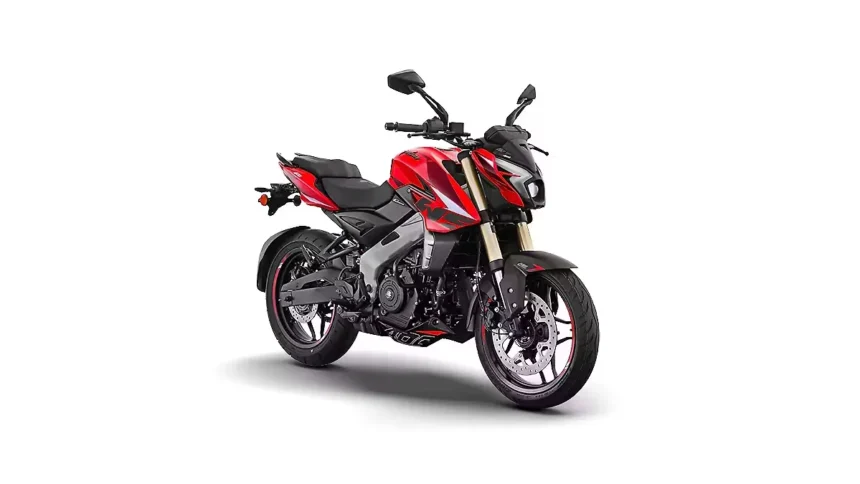
Bajaj Auto has silently updated the Pulsar NS400Z with a new 349cc engine, aligning it with its latest strategy of downsizing engines to fit under the revised GST norms. The update has been made official via the website, while the price continues to stand at Rs 1.93 lakh (ex-showroom, Delhi).
Engine Downsized To 349cc – Output Now At 40 BHP
The biggest change comes under the hood. The Pulsar NS400Z now uses a 349.13cc, liquid-cooled, single-cylinder engine, replacing the earlier 373cc motor.
- Power: 40–40.6 bhp @ 9,000 rpm
- Torque: 33.2 Nm @ 7,500 rpm
This marks a drop of 2.4 bhp and 1.8 Nm compared to the outgoing version. Interestingly, the output figures are now identical to the Dominar 400’s updated 350cc engine.
The revised motor also delivers peak performance higher in the rev band, indicating a slightly more peaky power delivery than before.
Bore Same, Stroke Reduced – Dominar 400 Connection
To achieve the lower displacement, Bajaj has reduced the engine stroke:
- Stroke: 56.1 mm (earlier 60 mm)
- Bore: 89 mm (unchanged)
This confirms that the engine is closely related to the unit seen on the Dominar 400, which also recently received a similar update.
No Other Changes Mechanically Or Visually
Apart from the new engine, the Pulsar NS400Z remains unchanged:
- Same perimeter frame
- USD front forks and rear monoshock
- 17-inch alloy wheels
- Disc brakes: 320 mm front, 230 mm rear
- Dual-channel ABS
Part Of Bajaj’s 350cc Strategy
Bajaj has been systematically moving its higher-capacity motorcycles—including KTM and Triumph-based models—towards the ~350cc bracket. With this update, the Pulsar NS400Z becomes the latest and final model in the lineup to adopt the downsized engine philosophy.
Conclusion
The Pulsar NS400Z continues to offer the same hardware and aggressive styling, but now with a smaller, slightly less powerful engine that prioritises compliance and efficiency. While performance enthusiasts may notice the drop, the unchanged pricing makes it a familiar value proposition in the segment.