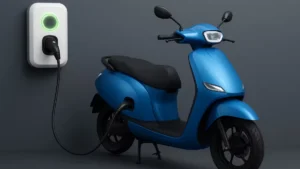
India’s electric two-wheeler market witnessed a sharp surge in March 2026, driven by year-end discounts, rising adoption in smaller cities, and the upcoming subsidy deadline. Registration data revealed a clear shift in market dynamics, with legacy manufacturers tightening their grip while newer players faced increasing competition.
TVS Motor Continues Market Leadership
TVS Motor Company retained its top position in India’s electric two-wheeler segment in March 2026, according to data from VAHAN portal. Total registrations for the month stood at 1,39,238 units, highlighting strong growth momentum in the EV space.
TVS Motor recorded 38,007 units, capturing a 27.3 percent market share. The company also maintained its dominance in the fourth quarter of FY26 with a 27.9 percent share. Strong demand for its iQube electric scooter, especially in Tier-2 markets, played a key role in sustaining its leadership.
Discounts and Subsidies Boost March Sales
March witnessed a surge in EV purchases driven by year-end discounts and incentives. Automakers rolled out exchange offers, financing schemes, and limited-period price cuts to clear inventory before the financial year closed.
Ola Electric introduced its “End ICE Age” campaign, offering attractive pricing and benefits of up to Rs 50,000 across its portfolio. The company also highlighted improved service timelines and customer support initiatives.
Similarly, Ather Energy announced offers of up to Rs 20,000 on its Rizta and 450 series scooters, including discounts and extended warranties.
Another major factor behind the spike in demand was the approaching deadline of the PM E-DRIVE Scheme, which ends on March 31, 2026. Buyers rushed to purchase electric two-wheelers before subsidies are withdrawn, as prices are expected to rise afterward.
Bajaj and Ather Strengthen Their Positions
Bajaj Auto secured the second spot with 33,447 registrations and a 24 percent market share, driven by steady demand for its Chetak electric scooter.
Ather Energy ranked third with 26,151 units and an 18.8 percent share, supported by consistent sales of its 450 lineup and Rizta family scooter.
Hero MotoCorp’s EV brand Vida claimed the fourth position with 15,683 units and an 11.3 percent share, reflecting gradual expansion across cities.
Ola Electric Slips to Fifth Place
Ola Electric recorded 6,381 units in March, accounting for a 4.6 percent market share and slipping to fifth position. Once a dominant player in 2023 and early 2024, the company has seen increased competition from legacy manufacturers with stronger dealer networks and improved supply chains.
Other Players and Market Trends
Among other manufacturers, Ampere registered 5,378 units (3.9 percent), while River sold 3,135 units (2.3 percent). BGauss reported 2,296 units, and Pure EV contributed marginal volumes. The “Others” category collectively accounted for 8,501 units, or 6.1 percent of total registrations.
The February 2026 data also reflected a similar trend, with TVS Motor leading at 29,231 units, followed by Bajaj Auto and Ather Energy.
Legacy OEMs Tighten Grip on EV Segment
The March 2026 data clearly indicates a shift in India’s EV two-wheeler market, with established manufacturers strengthening their hold. Improved distribution networks, better financing access, and expanding product portfolios have enabled legacy OEMs to outperform newer entrants.
With subsidies ending and competition intensifying, the coming months are expected to test pricing strategies and demand sustainability across the electric mobility segment.