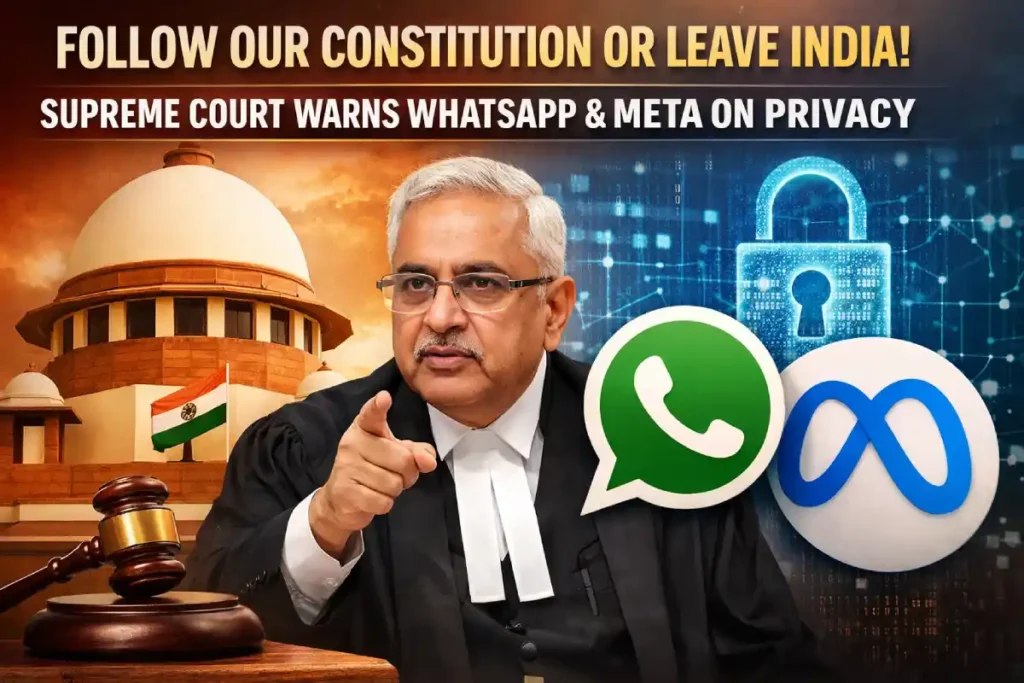
New Delhi, February 3, 2026 — India’s Supreme Court has taken a firm stand against WhatsApp and its parent company Meta Platforms Inc over concerns about user privacy and data-sharing practices, signalling that the rights of citizens cannot be compromised for corporate interests.
In a high-profile hearing on appeals filed by Meta and WhatsApp against a ₹213.14 crore penalty imposed by the Competition Commission of India (CCI) for alleged abuse of dominance through the 2021 privacy policy, a three-judge bench led by Chief Justice of India Surya Kant criticised the global tech giant’s approach to user consent and data sharing.
The Supreme Court emphasised that WhatsApp’s “take it or leave it” policy — which made expanded data-sharing with Meta entities a condition for continued use of its service — undermines the constitutional right to privacy and leaves users with no real choice. The bench questioned whether ordinary citizens, including those with limited literacy or technological understanding, could genuinely understand complex legal terms in privacy policies.
Chief Justice Surya Kant delivered a sharp admonition, declaring that not a single unit of user data should be shared in violation of Indian laws and underscoring that if WhatsApp and Meta cannot abide by the Indian Constitution and privacy norms, they are free to exit India.
Solicitor General Tushar Mehta, representing the Union of India, highlighted that personal data carries substantial economic value and criticised the policy as exploitative, especially where data could be used for targeted advertising without meaningful consent.
The apex court also directed Meta to file a clear affidavit undertaking that it would not share WhatsApp user data for advertising purposes. The court made clear that refusal to provide such an undertaking could result in dismissal of the company’s appeal.
The hearing is set to continue with interim orders expected on February 9, 2026, as the judiciary seeks to balance digital innovation with robust protection of citizen privacy rights.
Key Highlights:
- Supreme Court strongly rebukes WhatsApp and Meta for privacy terms seen as coercive and exploitative.
- Bench questions adequacy of user consent and opt-out mechanisms, especially for everyday users.
- Meta told to file undertaking to stop sharing user data for advertisements or risk dismissal.
- Interim order on the matter expected February 9, 2026.
This decision underscores India’s increasing scrutiny of global tech firms’ data practices and sets a significant precedent in digital privacy jurisprudence.